
A toolkit for rebuilding hope
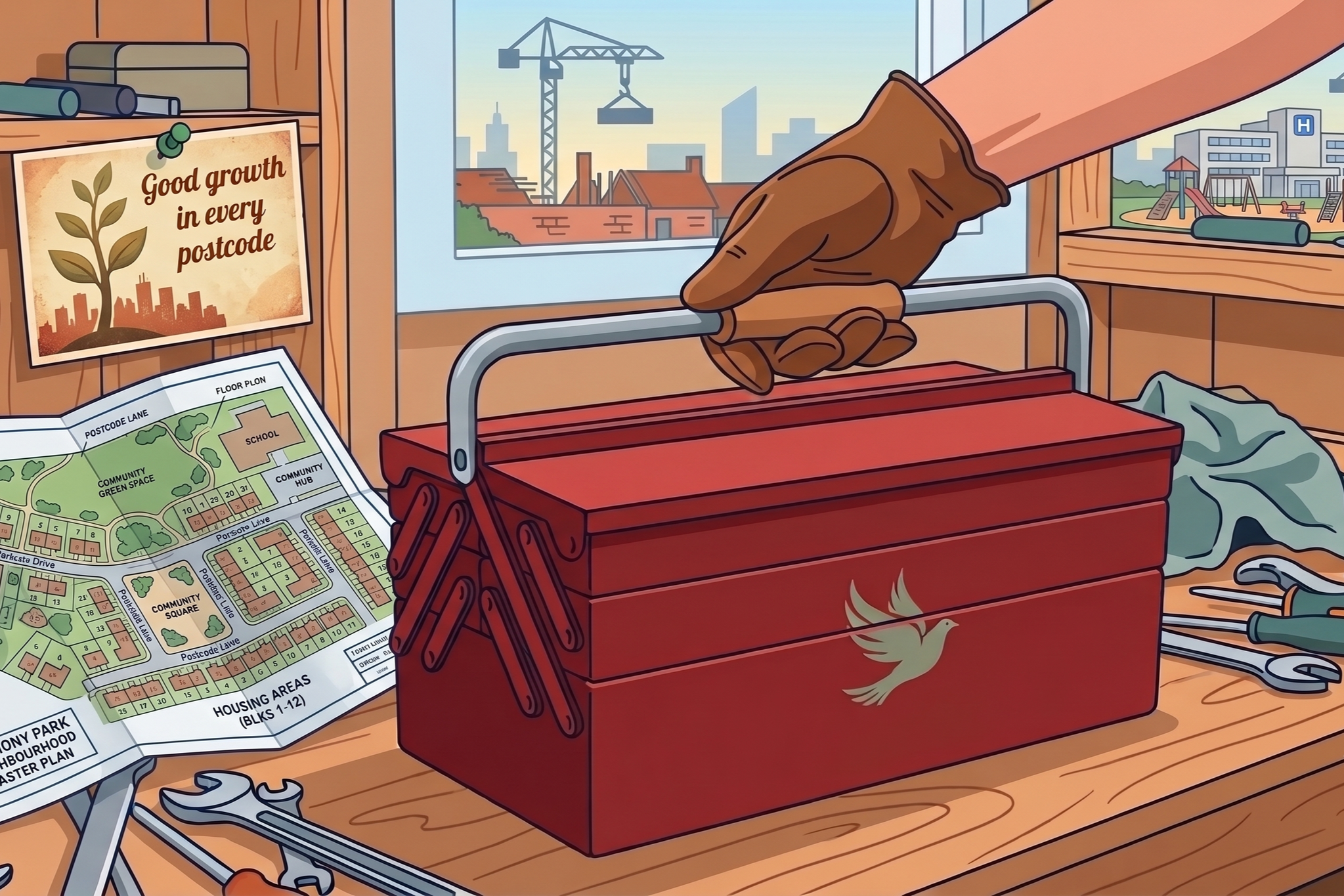
Three delivery tools that turn a hopeful story into lasting impact
In brief
Britain's new government has made hope its platform. Three key tools transform hope into lasting change:
- Shared leadership — local partners as co-authors of local ambition and strategy.
- Impact capital — pension funds, social investors and purpose-led businesses as genuine co-funders.
- Purposeful procurement — public spending as demand-side investment for local benefit.
A return to hope
Britain has a new Prime Minister. First in Makerfield and then at the Leadership Conference which put him in Downing Street, Andy Burnham put hope at the centre of his platform. This message of hope is a welcome relief from the sense of inexorable decline which has become entrenched in our public psyche. Better stories are essential to place-based transformation - but they are just the first step. To deliver true and lasting impact, they must be underpinned by infrastructure which transforms words into lived experience.
Rejecting the narrative of decline
The story a country tells about itself shapes what it believes it can do. For years Britain has been narrating its own decline. The mood is now measurable. In 2025, the Edelman Trust Barometer found six in ten people worldwide carrying a moderate-to-high sense of grievance; a year later its 2026 data records that grievance hardening into insularity, with three in four Britons now reluctant to trust those unlike them. Fewer than one in five in the UK believe the next generation will be better off — among the lowest anywhere, against a global average of 32%. Some of this gloom is legitimate, for sure; underinvestment in public services combined with rising living costs are real and painful. But some of it is manufactured by engagement-optimised algorithms that reward outrage, and by individuals who benefit from sowing disillusionment, and flourishes in the absence of a compelling alternative.
In my conversations with place leaders I routinely talk about the value of rescripting the stories we tell about our communities; to replace the well-worn narratives of loss and decline with an authentic account that connects the heritage of the past to a hopeful future. Burnham's choice of hope is exactly that kind of rescripting.
But a story only rebuilds trust if it proves true. The grievance Edelman measures is born of institutions people no longer believe will deliver for them. More words will not touch it, only delivery will. That is why the tools matter even more than the message: they are what turn a hopeful story from wishful thinking into something a person can see on their own street, in their own job, in their own bank account.
The architecture of hope
Back in June I was in Sheffield, facilitating a workshop on investing in outcomes for children and young people across South Yorkshire. To get to the venue I walked through Kelham Island, Sheffield’s former industrial heart. The regeneration of this post-industrial neighbourhood into a thriving mixed-use community is a powerful reminder that nowhere and no one is beyond redemption and transformation, given the right partnerships, vision and patience. What I see in place leaders from Cardiff to Leeds to Liverpool to Newcastle is that most places already hold the ingredients for place-based transformation. What they lack is the architecture that connects them and lets those elements compound. Hope, in other words, fails not for want of conviction but for want of connective tissue. Those working at local, regional and national level to deliver the new government’s hopeful agenda have to build that tissue deliberately.
In my experience, there are three critical tools place leaders need to foster prosperous, resilient and hope-filled communities: generosity in collaboration, impact capital mobilisation, and purposeful procurement.
A toolkit for hopeful government
Shared leadership, not delivery vehicles.
The organisations best placed to drive change on the ground — mission-led businesses, universities, anchor employers, impact investors, social enterprises — are often cast as delivery vehicles for public programmes rather than co-authors of local strategy. The most productive places already work differently.
In West London, AllChild joins up support for young people across borough and organisational boundaries, aggregating public contracts with social investment to amplify the resources reaching the children who need them most, transforming live chances. In the North East, Newcastle Helix, an innovation district co-led by Newcastle City Council, Newcastle University and Legal & General, has turned a former brewery site into a vibrant home for science, business and housing. Neither AllChild nor Helix emerged from the state or the market acting on its own; both came from partners who shared authorship of the opportunity, and compounded the advantage as a result.
Patient capital, deployed at scale.
Philanthropic and impact-driven investment remains underdeployed in Britain's most significant opportunities. This is not for want of appetite on behalf of investors, but for want of reliable access to the decisions that shape places. Where the access exists, the capital follows. The Greater Manchester Pension Fund has built a local investment portfolio that channels institutional money into housing and infrastructure across its own city-region: patient capital at scale, invested where its members live. At the other end of the spectrum, community anchors like Sharrow Community Forum steward assets and trust in one of Sheffield's most diverse neighbourhoods, transforming an ailing adventure play park into a hub of community renewal - precisely the kind of rooted institution long-horizon capital can back. The task is to treat pension funds, endowments and community vehicles as genuine co-investors in shared ambitions, not as vehicles to offset shortfalls in public finance.
Procurement as demand-side investment.
The new Prime Minister made references to procurement in his leadership speech and his first Downing Street address, rightly centring it as an underused tool for delivering policy priorities. The Procurement Act 2023, in force since February 2025, and the National Procurement Policy Statement that came with it, enhanced the tools available to contracting authorities. June's PPN 025, on procurement for national security and sovereign capability, presses in the same direction. Yet the State of Procurement 2026, which we co-produced with Bloom, found a disconnect between policy and practice, with price trumping strategic priorities like social value.
However, pioneers are showing what is possible: Cardiff Capital Region’s INFUSE programme connected private sector innovators to health service buyers to address a diagnostics backlog, leveraging catalytic public funds and a pathway into commercial deployment to mobilise private investment in R&D worth £17 million. Meanwhile, North Ayrshire's pioneering community wealth building is now the template for Scotland's Community Wealth Building Bill, a first-of-its-kind duty on councils and anchors to buy for local benefit. Choices like these involve courage and the permission structures in public authorities to make those choices stick in the face of competing pressures.
A rediscovery, not a reinvention
None of this is fundamentally new. It is a rediscovery of something Britain has done before, and done well. The Quaker industrialists — Cadbury, Rowntree, Barclays — built businesses of lasting global significance while embedding housing, healthcare, and education into the fabric of their enterprises. They did not wait for the state; they built because they believed business carried a real obligation to the communities from which it drew its labour and its markets.
Similarly, the early railway pioneers took risks no government would have sanctioned and connected places that had never been connected, generating transformation at a scale neither state nor market would have attempted alone. And Octavia Hill, backed by John Ruskin, who bought three run-down cottages for her to manage, built a model of affordable housing that became the template for modern housing associations.
These examples share a shape: private conviction, civic intent, long time horizons, and a willingness to act before institutional conditions fully caught up. That is the tradition a place-first government should be reaching for.
The way ahead
Declinism, at its core, is a failure of imagination. Andy Burnham has given us a new story: "a place-first, not a party-first, approach," problem-solving over point-scoring, a country that "works fairly for everywhere and everybody." He has bet his premiership that this hopeful story can overturn the narratives of retreat and grievance, and mobilise a new energy in Britain’s people and places.
The place leaders, investors, universities, anchor institutions and mission-led businesses essential to delivering this transformation already have many of the tools they need to accomplish the task, and a rich heritage of hope-driven pioneers to draw from. All that is left is the resolve to put them to use.
How we can help
The three tools in this piece are three of the things Recurve does.
Because patient capital only moves when places are ready to receive it, we help combined authorities, anchor institutions and investors build and mobilise impact-capital strategies — from capital readiness through the Impact for Places Academy to international capital through our UK–LatAm Investment Bridge.
Because procurement is the highest-leverage tool most places are not yet using well, we help public-sector leaders turn spending into market-building through the Alliance for Purposeful Procurement.
And because innovation ecosystems, districts and corridors compound only when their leadership connects them, we help places diagnose and build that architecture through the Innovation Ecosystem Leadership Academy.
Or write to hello@recurve.co · thirty minutes, no deck — bring your place's question.
Common questions
What is place-first government?
Place-first government puts place before party — problem-solving over point-scoring, working fairly for everywhere and everybody. It treats a hopeful story as a starting point, not a finish, and backs it with the infrastructure that turns words into delivery people can see on their own street.
What are the three tools for place-based transformation?
Shared leadership — treating businesses, universities and anchor institutions as co-authors of local strategy, not delivery vehicles. Patient capital — deploying pension funds, endowments and community vehicles at scale as genuine co-investors. Purposeful procurement — using public spending as demand-side investment for local benefit.
What is community wealth building in procurement?
It directs public spending toward local and social benefit rather than lowest price alone. North Ayrshire's pioneering model became the template for Scotland's Community Wealth Building Bill — a first-of-its-kind duty on councils and anchor institutions to buy for local benefit.
Why is hope a method, not a mood?
Because a hopeful story only rebuilds trust if delivery proves it true. Hope fails not for want of conviction but for want of connective tissue — the infrastructure, built deliberately, that lets a place's existing strengths compound.