
The resilience tool cities are leaving on the table
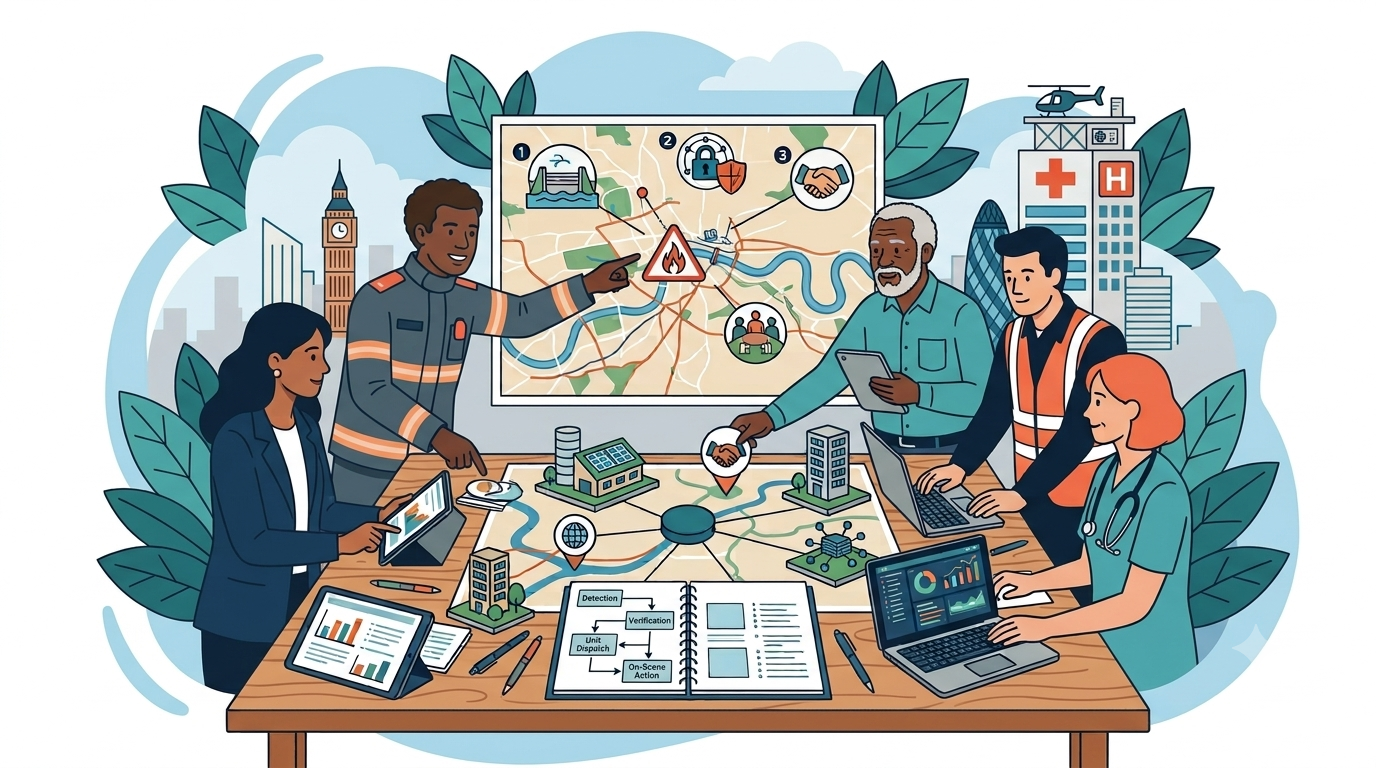
Strategic procurement is one of cities’ most underused tools for building resilience, local capacity and long-term climate impact.
First published by SmartCitiesWorld on 18 June 2026. Reproduced here with a July 2026 postscript.
In brief
Every public contract creates a dependency — on a supplier, on a supply chain, on infrastructure somebody else controls. It is almost never a question on the procurement form. Globally, cities spend around US$6 trillion a year. Almost none of it is examined as a resilience decision.
Why are cities stuck in safe mode, when it comes to public procurement?
Something has shifted in how city leaders talk about resilience. A few years ago, the conversation was largely technical – flood defences, heat mapping, net zero trajectories. Today it carries a different weight. The questions being asked are older and harder: how do we keep supply chains intact when global systems fracture? How do we maintain public trust when institutions have spent a generation losing it? How do we build communities with the depth and diversity to absorb shocks we cannot fully predict?
These are not questions that yield to a single policy lever or a single source of capital. They require something more like a posture – a settled commitment to building redundancy, local capacity and genuine strategic autonomy into the systems cities depend on. Not isolation, but the capacity to act when external conditions deteriorate. Cities have been here before. The history of urban resilience is largely a history of collective investment – in infrastructure, in institutions, in the connective tissue of local economies. The challenge now is to rediscover that capacity in conditions that make collaboration harder: tighter budgets, fractured trust, and a political climate that rewards visible short-term action over the patient work of system-building.
That is possible. But it requires being honest about what is getting in the way.
The lever hiding in plain sight: $6 trillion of city procurement
Most discussions of city resilience eventually arrive at the same question: where does the money come from? New capital, blended finance, green bonds – these are legitimate and necessary conversations. But cities already control a spending instrument of considerable power, one that touches every sector of the local economy and every community in their footprint. City governments worldwide spend approximately $6 trillion annually on goods and services – around 8 per cent of world GDP. Used strategically, that procurement power can build local supply chain depth, anchor domestic capabilities, strengthen social infrastructure and seed the kind of diversified, locally-embedded economies that genuinely withstand shocks.
Most of it is not being used that way.
Stuck in safe mode: what the State of Procurement 2026 data shows
Research published in our State of Procurement 2026 report, produced with Bloom, paints a clear picture of why – at least in the UK context, which mirrors pressures felt by city procurement teams across the developed world. The system is running in what we call Safe Mode: a defensive posture that prioritises procedural compliance over strategic value creation. Three forces drive it: bandwidth paralysis consuming 64 per cent of procurement teams in transactional firefighting; competing priorities that squeeze out ambition; and risk aversion that bundles contracts into large, single-supplier packages – creating precisely the concentration risks and single points of failure that a resilience agenda exists to prevent.
The data on climate ambition is particularly stark. Even as an aspiration, fewer than one in eight procurement professionals name climate action as a top commissioning priority. Under real budget conditions, that figure falls to zero – crowded out as the drive to deliver cashable savings surges from 6% to 28% as the dominant procurement logic. These are not the choices of people who don’t care about outcomes. They are the choices of people operating under impossible pressure in a system designed to reward caution.
The numbers
What safe mode costs, in figures
$6trn
Annual city government spend on goods and services worldwide — around 8% of world GDP.
Src: Global est.
64%
Of UK procurement teams consumed by transactional firefighting rather than strategic work.
Src: State of Procurement 2026
6 → 28%
The rise in cashable savings as the dominant procurement logic once real budget conditions bite.
Src: State of Procurement 2026
1 in 8
Fewer than one in eight procurement professionals name climate action a top commissioning priority. Under budget pressure, none do.
Src: State of Procurement 2026
95%
Emissions cut by Norway's electric ferry procurement — with costs down 80%.
Src: Norway regional govt
71%
Share of South Yorkshire MCA procurement spend now directed to SMEs.
Src: SYMCA
UK figures from State of Procurement 2026, Recurve with Bloom — read the report
The evidence behind this
State of Procurement 2026
The research this article draws on, produced with Bloom. The full diagnosis of a system running in safe mode — and what it would take to change it.
What breaking the pattern looks like
The encouraging reality is that city leaders across the world are already demonstrating what a different approach produces. The examples are instructive precisely because they are so varied in context.
In Norway, regional governments used ferry procurement contracts to require low-emission technologies across all new routes. The market responded: electric ferries replaced diesel, cutting emissions by 95per cent and costs by 80 per cent. The mechanism was not a subsidy or a grant – it was a purchasing decision, made in advance and held to consistently, that pulled the market toward a public priority and built a new domestic industrial capability in the process.
In Ithaca, New York, facing the challenge of decarbonising 6,000 ageing buildings with an $80 million annual city budget, leaders aggregated demand across blocks of properties and orchestrated a bulk advance purchase of heat pump and retrofit technologies – securing a 30 per cent cost reduction and attracting $105 million in private co-investment. Strategic procurement as pipeline development.
In Wales, the Well-being of Future Generations Act has created a statutory duty to consider the long-term impact of public spending decisions – a legal architecture that gives procurement teams the political cover and institutional backing to resist short-term cost pressure in favour of durable outcomes. It is the closest any legislature has come to hardwiring the reboot at a systemic level, and its influence on procurement culture in Wales is increasingly tangible.
Meanwhile, South Yorkshire Mayoral Combined Authority now directs 71% of its procurement spend to SMEs – building local supply chain depth and keeping economic multipliers circulating within the regional economy. That is strategic autonomy expressed through purchasing decisions, not trade policy.
An alliance for what comes next
These examples share a common thread: visible, sustained leadership willing to use the permissions that already exist. The regulatory frameworks in the UK, across the EU, and in many US jurisdictions now formally authorise public bodies to move beyond the bottom line – to act as architects of strategic impact rather than passive consumers of the lowest bid. The European Committee of the Regions has recently called explicitly for procurement to become a lever for European resilience and strategic autonomy, with stronger support for local and regional supply chains across energy, clean technology and critical sectors.
The missing ingredient is not permission. It is the institutional courage and peer solidarity to act on it – and the collaborative infrastructure to share what works.
The system is ready. The tools exist. The only remaining question is whether city leaders are willing to lead.
Does procurement really improve resilience?
Yes, when it is treated as a design decision rather than a compliance exercise.
Procurement determines supplier concentration, supply chain depth and the infrastructure a service depends on. Bundled single-supplier contracts engineer exactly the single points of failure that resilience planning exists to prevent; lotted, locally-embedded contracts do the opposite.
Editor's note — July 2026
Since this was published, the argument has sharpened. The question is not only what public spending buys, but what it quietly makes a place depend on — a supplier, a supply chain, a piece of infrastructure controlled elsewhere. That is the territory the Alliance for Purposeful Procurement is taking on through 2026/27, under the working title Phantom Sovereignty.
We have written separately on what the new national security guidance changes for public buyers, and on the harder question it leaves behind.
Equipping leaders to adopt procurement as a tool for delivering resilience and other strategic goals is why we created the Alliance for Purposeful Procurement. Join as a partner or a practitioner.
The Alliance for Purposeful Procurement
Where we take these questions next. Three ways in.
01 — Organisations
Become a founding partner
Help shape and resource the agenda from the front of the coalition. We're talking to a small number of organisations.
Start the conversation →02 — Practitioners
Join the network
For people doing this work day to day. Share experience, learn from others, stay close to the thinking. Free.
Join the network →03 — Evidence
Read the evidence
The diagnosis behind it all: State of Procurement 2026, the report that started the Alliance.
Read the report →